Long description: Fig363_2
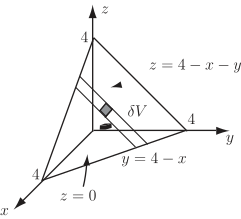
Alt text: A three-dimensional graph illustrating the volume element \(\Delta V\) under a plane defined by \(z = 4 - x - y\).
This description was generated by AI and has not been verified by a human. If you spot an error, please use the feedback link below.
- The image displays a three-dimensional coordinate system with axes labeled \(x\), \(y\), and \(z\), each scaled from zero to four.
- A plane intersects the axes at the points \((4, 0, 0)\), \((0, 4, 0)\), and \((0, 0, 4)\), forming a triangular cross-section on the plane \(z = 4 - x - y\).
- The boundaries of this plane are indicated by equations: \(z = 4 - x - y\), \(z = 0\), and \(y = 4 - x\).
- Within the volume enclosed by the coordinate planes and the slanted plane, a small rectangular volume element, denoted as \(\Delta V\), is shown, indicating an infinitesimal slice of the volume.
- The labeling suggests that the volume integration is taking place within the region defined by \(x \ge 0\), \(y \ge 0\), \(z \ge 0\), and \(z \le 4 - x - y\).