Long description: Fig363a_5
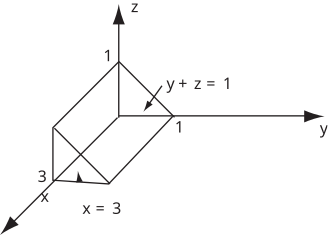
Alt text: A three-dimensional graph showing a triangular prism bounded by the coordinate planes and the plane defined by the equation \(y+z=1\), with the intersection of the \(x\)-coordinate being \(x=3\).
This description was generated by AI and has not been verified by a human. If you spot an error, please use the feedback link below.
- The image displays a three-dimensional Cartesian coordinate system with axes labeled \(x\), \(y\), and \(z\).
- A solid shape, which resembles a prism or wedge, is drawn in the first octant defined by the intersection of the planes \(x=3\), \(z=0\), and \(y=0\).
- One of the faces of the solid is clearly labeled with the equation \(y+z=1\).
- The boundary of the solid along the \(x\)-axis is indicated by the plane \(x=3\).
- The vertices and edges suggest that the solid occupies the region where \(0 \text{ \text{less than } } z \text{ \text{less than } } 1-y \text{, } 0 \text{ \text{less than } } y \text{ \text{less than } } 1 \text{, and } 0 \text{ \text{less than } } x \text{ \text{less than } } 3 \text{ (or perhaps } x=3 \text{ is a boundary plane instead of a limit)}\).
- The labeling on the axes shows that the dimensions or planes are set at \(x=3\), \(y=1\), and \(z=1\) for the intersecting planes forming the visualized region.