Long description: current
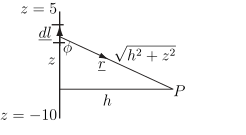
Alt text: A diagram illustrates the relative positions of a current element, point P, and the perpendicular distance separating them.
This description was generated by AI and has not been verified by a human. If you spot an error, please use the feedback link below.
- The image displays a coordinate system with a vertical axis labeled with \(z\) ranging from \(-10\) to \(5\), and a horizontal axis representing a distance \(h\).
- A small segment labeled \(dl\) is shown on the vertical axis at \(z=5\), representing a current element.
- A point labeled \(P\) is located some distance \(h\) along the horizontal axis from the vertical axis.
- A right-angled triangle is formed connecting the current element \(dl\), the point \(P\), and a point horizontally aligned with \(dl\) and vertically aligned with \(P\).
- The perpendicular distance from the current element \(dl\) to the point \(P\) is labeled \(\rho\) and is mathematically represented as \(\text{sqrt}(h^2 + z^2)\), indicating the length of the hypotenuse connecting the two points.
- The horizontal separation is labeled \(h\), and the vertical separation is also indicated by the length \(z\) along the axis.