Long description: heatgrid
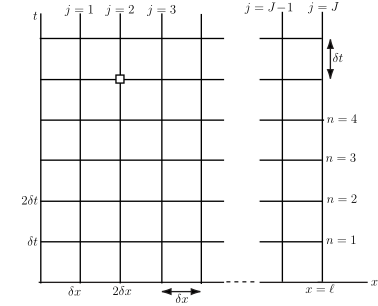
Alt text: The image displays a grid on the left with dimensions labeled by \(\delta x\), \(2\delta x\), and \(3\delta x\) along the horizontal axis, and a grid on the right with horizontal lines labeled by \(n=1\) through \(n=4\) and a vertical dimension labeled by \(\delta t\).
This description was generated by AI and has not been verified by a human. If you spot an error, please use the feedback link below.
- The image consists of two separate grids, both representing a coordinate system for numerical methods.
- The grid on the left is defined by a horizontal axis labeled \(j=1\), \(j=2\), and \(j=3\), with corresponding spacing labeled by \(\delta x\), \(2\delta x\), and \(3\delta x\).
- A small square marker is placed on the intersection corresponding to \(j=2\).
- The grid on the right is oriented vertically, with horizontal lines labeled \(n=1\), \(n=2\), \(n=3\), and \(n=4\), indicating discrete values along the vertical axis.
- The vertical dimension is labeled by \(\delta t\), and the horizontal axis is indicated by a dashed line labeled \(x=\ell\).
- Both grids utilize grid lines, suggesting a spatial discretization for a problem involving partial differential equations.