Long description: ex2fig2
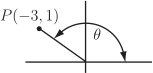
Alt text: A coordinate plane shows an angle \(\theta\) in the second quadrant, with an arc drawn from the positive x-axis counterclockwise to the terminal side of the angle, and a point labeled \((-3, -1)\) plotted on the terminal side.
This description was generated by AI and has not been verified by a human. If you spot an error, please use the feedback link below.
- The image displays a standard two-dimensional Cartesian coordinate system with a horizontal x-axis and a vertical y-axis, intersecting at the origin.
- A point is plotted in the second quadrant at the coordinates \((-3, -1)\). Note: Based on the angle shown, the coordinates are likely intended to be \((-3, 1)\) or \((-3, y)\) where \(y\) is positive, but the label clearly shows \((-3, -1)\).
- An arc representing an angle \(\theta\) is drawn starting from the positive x-axis and sweeping counterclockwise through the second quadrant until its terminal side passes through the plotted point.
- The angle \(\theta\) is marked above the arc.