Long description: glass
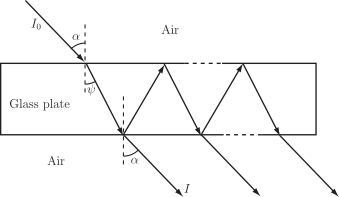
Alt text: The diagram illustrates the geometry of a light ray interacting with a glass plate, showing angles of incidence, refraction, and reflection.
This description was generated by AI and has not been verified by a human. If you spot an error, please use the feedback link below.
- A light ray, labeled with the initial angle \(\alpha\), approaches a rectangular block labeled "Glass plate" from the top left, originating in a region labeled "Air".
- At the interface, the angle of incidence is indicated by an angle \(\alpha\) relative to the normal line drawn at the surface.
- After passing through the "Glass plate", the ray refracts into the second region labeled "Air". This refracted ray makes an angle of refraction, also labeled \(\alpha\), with the normal line drawn in this second region.
- There is a dashed line representing the path of the light ray after transmission and another dashed line representing the path of a reflected ray, both originating from the top interface.
- The diagram shows a relationship between the incident angle \(\alpha\) and the angle of refraction, with the final transmitted ray labeled with a downward arrow and an angle \(\alpha\) relative to the normal line.