2 Curvature for parametrically defined curves

An expression for the curvature is also available if the curve is described parametrically:

x = g ( t ) y = h ( t ) t 0 ≤ t ≤ t 1

We remember the basic formulae connecting derivatives

d y d x = ẏ ẋ d 2 y d x 2 = ẋ ÿ − ẏ ẍ ẋ 3

where, as usual ẋ ≡ d x d t , ẍ ≡ d 2 x d t 2 etc.

Then

κ = f ″ ( x ) { 1 + [ f ′ ( x ) ] 2 } 3 ∕ 2 = ẋ ÿ − ẏ ẍ ẋ 3 1 + ẏ ẋ 2 3 ∕ 2

= ẋ ÿ − ẏ ẍ [ ẋ 2 + ẏ 2 ] 3 ∕ 2

Key Point 7

The formula for curvature in parametric form is κ = ẋ ÿ − ẏ ẍ [ ẋ 2 + ẏ 2 ] 3 ∕ 2

Task!

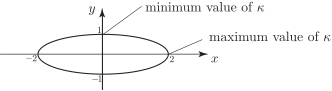
An ellipse is described parametrically by the equations

x = 2 cos t y = sin t 0 ≤ t ≤ 2 π

Obtain an expression for the curvature κ and find where the curvature is a maximum or a minimum.

First find ẋ , ẏ , ẍ , ÿ :

ẋ = − 2 sin t ẏ = cos t ẍ = − 2 cos t ÿ = − sin t

Now find κ :

κ = ẋ ÿ − ẏ ẍ [ ẋ 2 + ẏ 2 ] 3 ∕ 2 = 2 sin 2 t + 2 cos 2 t [ 4 sin 2 t + cos 2 t ] 3 ∕ 2 = 2 [ 1 + 3 sin 2 t ] 3 ∕ 2

Find maximum and minimum values of κ by inspection of the expression for κ :

Denominator is max when t = π ∕ 2 . This gives minimum value of κ = 1 ∕ 4 ,

Denominator is min when t = 0 . This gives maximum value of κ = 2.

A graph showing a horizontal ellipse centered at the origin, with labels indicating the minimum and maximum values of kappa.

Long description