4 Exponential decay
As we have noted, the behaviour of as is called exponential growth. In a similar manner we characterise the behaviour of the function as as exponential decay . The graphs of and are shown in Figure 3.
Figure 3 :
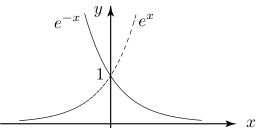
Exponential growth is very rapid and similarly exponential decay is also very rapid. In fact tends to zero so quickly as that, no matter how large the constant is,
The next Task investigates this.
Task!
Choose in the expression and calculate using your calculator for .
| 5 | 10 | 15 | 20 | 25 | 30 | 35 | |
| 1.7 | |||||||
The topics of exponential growth and decay are explored further in Section 6.5.
Exercises
-
Find, to 3 d.p., the values of
- Plot and for . For which integer values of is ?
-
- 0.004
- 676.520
- 125
- 0.0
- 1.414
- 36.462
- 2.193
-
0.400
- For integer values of , if