3 Standard conics in polar coordinates
In the previous Section we merely stated the standard equations of the conics using Cartesian coordinates. Here we consider an alternative definition of a conic and use this different approach to obtain the equations of the standard conics in polar form. Consider a straight line (this will be the directrix of the conic) and let be the eccentricity of the conic ( is a positive real number). It can be shown that the set of points in the plane which satisfy the condition
is a conic with eccentricity . In particular, it is an ellipse if , a parabola if and a hyperbola if . See Figure 14.
Figure 14
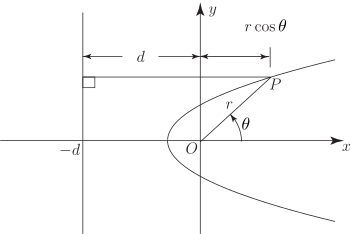
We can obtain the polar coordinate form of this conic in a straightforward manner. If has polar coordinates then the relation above gives
Thus, solving for :
This is the equation of the conic.
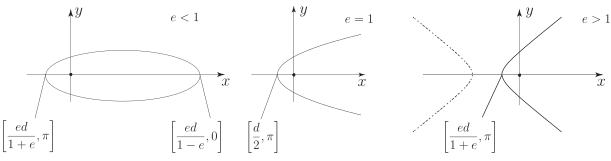
In all of these conics it can be shown that one of the foci is located at the origin. See Figure 15 in which the pertinent details of the conics are highlighted.
Figure 15
Task!
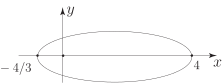
Sketch the ellipse and locate the coordinates of its vertices.
Exercises
-
Sketch the polar curves
- .
-
Find the polar form of the following curves given in Cartesian form:
-
Find the Cartesian form of the following curves given in polar form
Do you recognise these equations?
-
Long description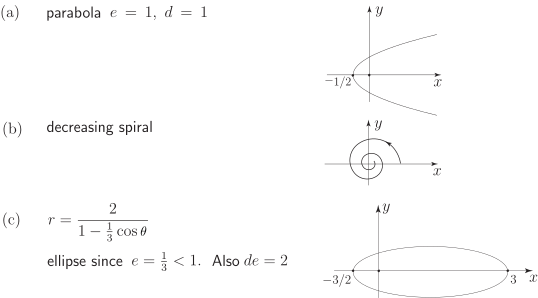
-
-
- which is a straight line
- in standard form: i.e. a circle, centre with radius