

5 Solving equations
When we work out the value of an unknown, say \(x\), in an equation we say that we are solving for \(x\). To work out the value we are free to apply any mathematical operation we like to the equation so long as we do the same to both sides.
Note: We can’t quite do any operation. Division by zero, \(\div 0\), is not allowed as it is undefined.
5.1 Linear equations
5.1.1 Single unknown
Keeping the idea of doing the same thing to both sides in mind lets solve the following equation by undoing each operation with it’s inverse.
\[ 3x + 8 = 10 \] First subtract \(8\) from each side.
\[ \begin{aligned} 3x+8 -8 &= 10 -8 \\ 3x &= 2 \end{aligned} \]
Now divide both sides by \(3\) to find the value of one \(x\).
\[ \begin{aligned} \frac{3x}{3} &= \frac{2}{3} \\ x &= \frac{2}{3} \end{aligned} \]
The nice thing here is that we can leave the answer as \(\frac{2}{3}\). No need to find a decimal fraction if we don’t need to.
Solve the following equations by applying the same operation to both sides. Remember the questions come with full solutions, so, if you get stuck have a look at the answers and then try a different one.
5.1.2 Unknown on both sides
If the unknown appears twice in an equation collect the unknown like terms first and then solve as before.
Given \(\frac{4y}{y-9}=-2\), we can multiply both sides by \((y-9)\) to get rid of the fraction, then get all the \(y\)s on one side, then finally solve as before.
\[ \begin{aligned} \frac{4y}{y-9} &= -2 \\ \frac{4y}{y-9} \times (y-9) &= -2 \times (y-9) \\ \frac{4y}{\cancel{y-9}} \times \cancel{(y-9)} &= -2 \times y -2 \times -9 \\ 4y &= -2y + 18 \\ 4y + 2y &= -2y + 18 +2y\\ 6y &= 18\\ \frac{6y}{6} &= \frac{18}{6}\\ y &= 3 \end{aligned} \]
- To solve equations do the same thing to both sides.
- If the unknown appears twice - collect like terms first.
Have a go at some questions. You’ll need a pen and paper to work these out.
5.2 Inequalities
Solving inequalities works just like solving a normal equation except when you divide or multiply by a negative number the inequality symbol changes direction. Here are some examples.
Addition and subtraction work.
\[ \begin{aligned} 1 &< 2 \\ 1 + 5 &< 2 + 5\\ 6 &< 7\\ &\checkmark&\\ \end{aligned} \] \[ \begin{aligned} 1 &< 2 \\ 1 -4 &< 2 -4\\ -3 &< -2\\ &\checkmark \end{aligned} \]
Remember \(-3\) is less than \(-2\) since it is further to the left on a number line. In other words \(-3\) is more negative than \(-2\).
Multiplication and division work as expected with positive numbers.
\[ \begin{aligned} 4 &< 6 \\ 4 \times 2 &< 6 \times 2\\ 8 &< 12\\ &\checkmark \end{aligned} \] \[ \begin{aligned} 4 &< 6 \\ 4 \div 2 &< 6 \div 2\\ 2 &< 3\\ &\checkmark \end{aligned} \]
We need to be careful when multiplying and dividing by negative numbers.
\[ \begin{aligned} 4 &< 6 \\ 4 \times -2 &< 6 \times -2\\ -8 &\nless -12\\ -8 &> -12 \end{aligned} \]
Remember the following key point when using inequalities:
When multiplying or dividing by a negative number change the direction of the inequality.
5.3 Simultaneous equations
Sometimes equations have more than one unknown. Take \(x + y = 4\) for example. There are infinitely many pairs of numbers, \(x\) and \(y\), that work for this. Take the following pairs for example: \(x = 1\) and \(y=3\), \(x = -100\) and \(y=104\), and \(x = 0.1\) and \(y=3.9\).
These pairs of solutions are often given as co-ordinate pairs like \((1,3)\), \((-100,104)\) and \((0.1,3.9)\). We’ll do more about co-ordinates later.
However, if I give you some more information, say \(x = y\), now there is only one solution, namely \(x = 2\) and \(y=2\). We can use the information in two equations together to find the values that satisfy both equations.
5.3.1 Elimination method
The idea with this method is to combine the two equations to create a new equation with only one variable in it.
\[ \begin{aligned} 4x + 2y &= -6 &(1)\\ -2x + 3y &= 7 &(2) \end{aligned} \]
To get a solution for \(y\), if we multiply equation \((2)\) by \(2\) we will have two equations with equal and opposite x-coefficients:
\[ \begin{aligned} 4x + 2y &= -6 \\ -4x + 6y &= 14 &(3) \end{aligned} \]
If we add equation \((1)\) to equation \((3)\) this eliminates the \(x\)-terms, leaving us with one equation in terms of \(y\):
\[ \begin{aligned} (2+6)y &= -6 + 14 \\ 8y &= 8 \\ y &= 1 \end{aligned} \]
To obtain a solution for \(x\) we can substitute this \(y\)-value into either of our initial equations. Using equation \((1)\), we obtain:
\[ \begin{aligned} 4x + 2 \times 1 &= -6 \\ 4x + 2 &= -6 \\ 4x &= -8 \\ x &= -2 \end{aligned} \]
We can check our values for \(x\) and \(y\) by substituting them into equation \(2\).
\[ \begin{aligned} -2x + 3y &= 7 \\ -2 \times -2 + 3 \times 1 &= 7 \\ 4 + 3 &= 7 \end{aligned} \]
Which works out!
In economics, market equilibrium occurs where the quantity demanded equals quantity supplied. You’re making just the right amount. If you made any more, they would be unsold, and if you made any less, you would miss out on an opportunity. It’s useful to find out exactly where this point is, or in other words, where the equilibrium lies.
The demand for an item usually depends on the price. Typically, the higher the price, the less people want to buy. The supply of an item also depends on the price. The higher the price, the more producers are willing to make.
We usually use the letters P and Q to represent price and quantity in economics.
Imagine a student bake sale. Let £P be the price of one brownie and Q be the number of brownies.
Demand tells us how many brownies the buyers want:
\[ P + Q = 8 \]
If brownies were free, 8 people would take one. But for every £1 the price goes up, one person decides it is not worth it. When the price is £7, only one person wants a brownie. When the price is £8, no one wants a brownie.
Supply tells us how many brownies the bakers are willing to make:
\[ -P + Q = -2 \]
The bakers will not switch the oven on unless they can charge at least £2 (to cover ingredients). For every extra brownie, they need another £1 to make it worth their time.
Adding the two equations eliminates \(P\):
\[ 2Q = 6 \]
So \(Q = 3\). Substituting back into the demand equation:
\[ P + 3 = 8 \implies P = 5 \]
The equilibrium price is £5 per brownie, and 3 brownies are baked and sold.
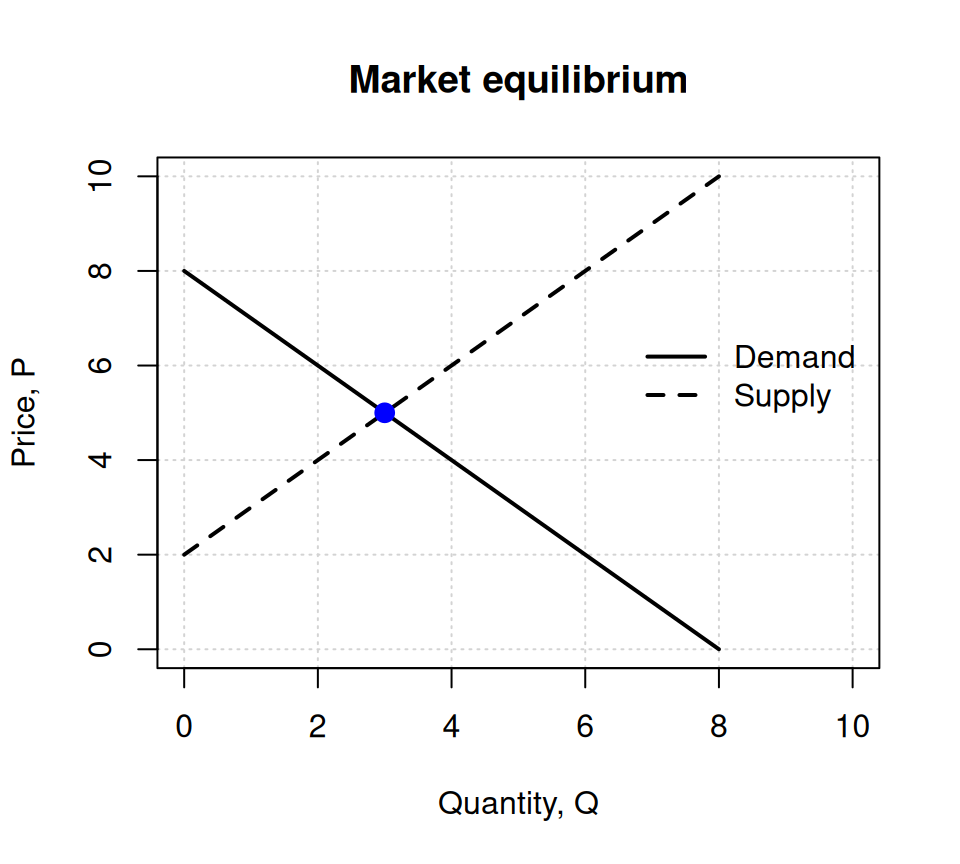
When \(Q=3\) and \(P=5\), the quantity supplied equals the quantity demanded, and the market is said to be in equilibrium. You will also commonly hear the phrase the market has cleared. This is a metaphor based on the idea of a market as a physical place where buyers and sellers meet. In this metaphor, the market “clears” when all goods are sold and there are no unsatisfied buyers or sellers. (Everyone clears off home, and there’s no one left trying to buy or sell anything.) In reality, markets are often more complex and may not clear perfectly, but the concept of equilibrium is still a useful tool for understanding how prices and quantities are determined in a market economy.
You can try other examples in the exercise below. Sometime you may have to multiply both of your starting equations in order to get the same amount of one variable. Also, don’t worry if you have eliminated the other variable - it doesn’t matter which you get rid of first, you should get the same answer in the end.
5.3.2 Substitution method
It is also possible to re-arrange one equation and substitute it into the other. This method will be covered in the Quadratics section.