

12 Logarithms
Logarithms, or logs for short, are the same as powers just written in another way.
12.1 Reverse of indices
NoteKey point:
If \(a^y =x\) then \(y = \log_{a} x\).
\(a\) is called the base of the logarithm. When dealing with logs it’s often useful to think of a numerical example to keep the idea straight in your head.
\[ \begin{aligned} 10^3 &= 1000 \\ 3 &= \log_{10} 1000 \end{aligned} \] This is the same fact written in index notation and as a logarithm.
12.2 Rules of logarithms
Just as there are rules when dealing with indices, there are the corresponding rules when dealing with logarithms too.
NoteKey point:
- \(\log_{a} x + \log_{a} y = \log_{a} xy\)
- \(\log_{a} x - \log_{a} y = \log_{a}{\frac{x}{y}}\)
- \(\log_{a} x^n = n\log_{a} x\)
We can use these rules to manipulate algebraic expressions. For example, let’s write the following as a single logarithm:
\[ \begin{aligned} 3\log_{10} 2 + \log_{10} 5 - \log_{10} 4 &= \log_{10} 2^3 + \log_{10} 5 - \log_{10} 4 \\ &= \log_{10} 8 + \log_{10} 5 - \log_{10} 4 \\ &= \log_{10} (8 \times 5) - \log_{10} 4 \\ &= \log_{10} 40 - \log_{10} 4 \\ &= \log_{10} (\frac{40}{4}) \\ &= \log_{10} (10) \\ &= 1 \end{aligned} \] This is how it was done:
- First we used the power rule \(\log_{a} x^n = n\log_{a} x\),
- then the addition rule \(\log_{a} x + \log_{a} y = \log_{a} xy\),
- and finally, the subtraction rule \(\log_{a} x - \log_{a} y = \log_{a}{\frac{x}{y}}\).
- Then notice \(\log_{10} (10)= 1\) since \(10^1=10\).
CautionEconomics example
The Cobb-Douglas production function is widely used in economics:
\[ Y = A K^{\alpha} L^{\beta} \]
The letters stand for:
- \(Y\): total output (what the firm or country produces)
- \(K\): capital (machinery, buildings, equipment, infrastructure)
- \(L\): labour (hours worked or number of workers)
- \(A\): total factor productivity, a catch-all for technology, efficiency and anything else that affects output besides capital and labour
- \(\alpha\) and \(\beta\): the output elasticities of capital and labour. They tell you by what percentage output changes when capital or labour increases by one percent
Taking natural logarithms of both sides and applying the log rules gives:
\[ \ln Y = \ln A + \alpha \ln K + \beta \ln L \]
This turns a multiplicative relationship into a linear one. Once the equation is linear, economists can use regression to estimate \(\alpha\) and \(\beta\) from real data.
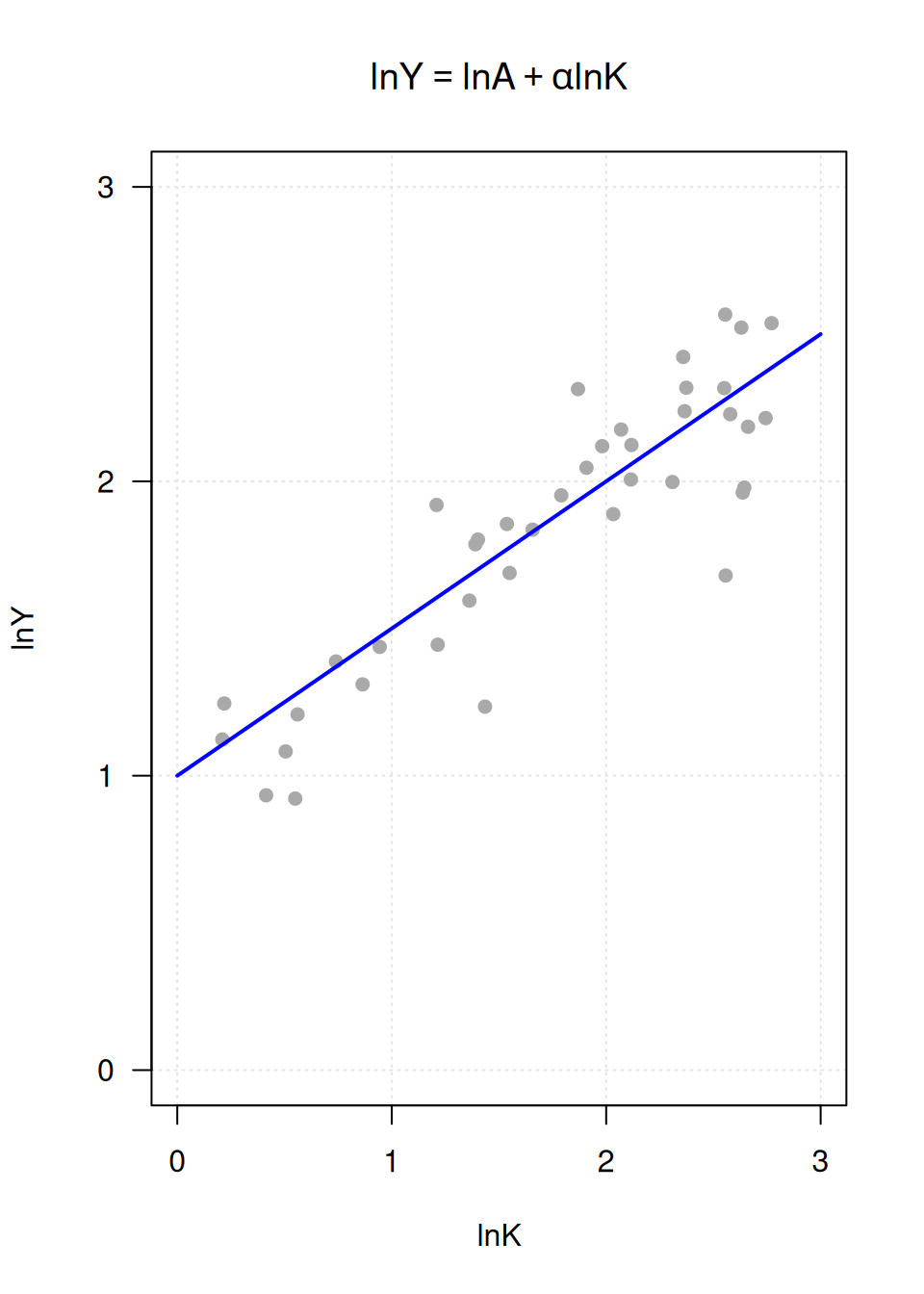
Regression is a statistical technique that finds the straight line that best fits a cloud of data points. It works by minimising the sum of squared vertical distances between the line and all the points. If you have data on output, capital and labour from many firms or many years, you regress \(\ln Y\) on \(\ln K\) and \(\ln L\). The slope for each input gives you the corresponding elasticity directly: the slope on \(\ln K\) is \(\alpha\) and the slope on \(\ln L\) is \(\beta\). The intercept gives you \(\ln A\).
The diagram below shows what this looks like in a simplified case where only capital varies (labour is held constant). Each grey dot is an observation from a different firm or year. The blue line is the best fit found by regression.
Have a go at these simplification questions.
12.3 Solving equations with logarithms in
For example, let’s solve \(3\log_{10} x + \log_{10} 2 = \log_{10} 250\). First we’ll apply the power rule \(\log_{a} x^n = n\log_{a} x\), then the addition rule \(\log_{a} x + \log_{a} y = \log_{a} xy\):
\[ \begin{aligned} 3\log_{10} x + \log_{10} 2 &= \log_{10} 250 \\ \log_{10} x^3 + \log_{10} 2 &= \log_{10} 250 \\ \log_{10} 2x^3 &= \log_{10} 250 \end{aligned} \]
Now since the two sides are equal the values inside the logarithm must be equal. We can then go ahead and solve the resulting equation as normal.
\[ \begin{aligned} \log_{10} 2x^3 &= \log_{10} 250 \\ 2x^3 &= 250 \\ x^3 &= 125 \\ x &= \sqrt[3]{125} \\ &= 5 \end{aligned} \]
Have a go at the following questions:
12.4 Some important bases
Some bases in logarithms come up more than others, because of that some bases have their own notation.
12.4.1 The natural logarithm
A logarithm that has \(e\) as it’s base is known as the natural logarithm and has it’s own symbol.
NoteKey point:
\[ \log_{e} x = \ln{x} \]
12.4.2 Base 10
A logarithm that has \(10\) as it’s base has it’s own symbol.
NoteKey point:
\[ \log_{10} x = \log{x} \]
You just don’t bother writing the base.
12.5 Differentiating \(\ln{x}\)
The rule for differentiating \(\ln{x}\) is:
NoteKey point:
if \(y = k\ln{ax}\) then \(\frac{dy}{dx}= \frac{k}{x}\).
Use that rule to try the following questions.